How are sheet metal parts calculated automatically?
Automize your calculation. Find the steps involved in the digital calculation process for sheet metal parts.
How are sheet metal parts calculated automatically?
Automize your calculation. Find the steps involved in the digital calculation process for sheet metal parts.
In today's fast-paced manufacturing landscape, accuracy and efficiency are crucial. Oroox is revolutionizing the sheet metal industry by leveraging a sophisticated detection algorithm with built-in functionality for both design and manufacturing. This innovative solution automates the complex process of calculating sheet metal parts, which involves a deep understanding of material properties, geometric transformations, and key manufacturing considerations.
By streamlining these intricate calculations, Oroox provides manufacturers with a powerful tool that optimizes both production quality and cost. Below is a detailed breakdown of the process, from detecting parameters to calculating the final price.
1. Detection of Parameters
- Material Selection: Choosing the available material (e.g., type of steel, type of aluminum) and detecting its thickness. This is crucial because the material type affects the bendability and cost.
- Dimensions: The key dimensions of the part such as length, width, height, net surface and thickness are extracted. These will impact how the part is flattened and bent.
- Bending Characteristics: Identifying bending lines, angles, and the radii of the part, since these will determine the bend allowance and deduction values.
- Tolerances and Surface Treatments: Special machining or surface treatments like powdercoating or anodizing can impact cost and process steps.
2. Flattening the Part
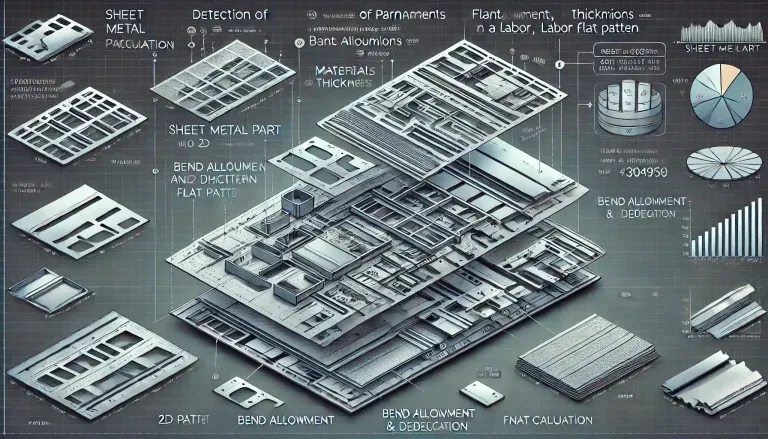
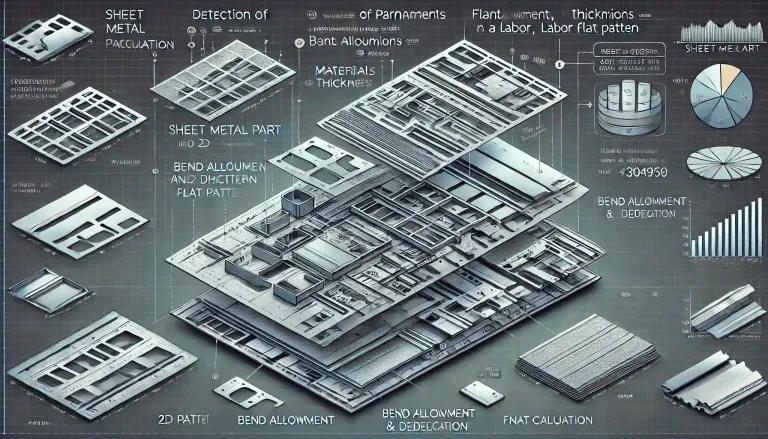
- Unfolding Geometry: The 3D geometry of the part is unfolded into a 2D flat pattern. This requires accurate flattening algorithms that account for the effects of bending.
- Neutral Axis Position: The location of the neutral axis during bending is crucial for accurate flattening. This is typically at a percentage of the material thickness (e.g., 50%).
3. Bend Allowance Calculation
- Bend Allowance (BA): Bend allowance is the amount of material required to accommodate the bend. It depends on the bend angle, radius, and material properties.
- K-Factor: The K-factor is determined experimentally and based on material properties and thickness. It can also be adjusted for various types of bends (e.g., air bending vs. bottom bending).
4. Bend Deduction or Bend Compensation
- Bend Deduction (BD): Bend deduction accounts for the material loss when bending. This value is subtracted from the total length to determine the flat pattern size.
- Bend Compensation (BC): Bend compensation adjusts the flat length of the sheet metal to ensure it meets the desired final dimensions after bending. BC is the difference between the initial flat length and the final bent part length.
5. Nesting and Material Optimization
- Nesting: Efficiently laying out multiple parts on a sheet of metal is critical to minimize material waste. Nesting algorithms use the flat patterns and arrange them in such a way that the maximum number of parts is cut from the sheet with minimal waste.
- Material Usage Optimization: Advanced nesting techniques, such as linear programming or heuristic algorithms, are employed to reduce scrap and optimize material usage, which directly impacts cost efficiency.
6. Rule-based calculation
- Material Cost: The system calculates the raw material cost based on the material, thickness, and quantity of material used, which is influenced by the results of the nesting.
- Cutting Costs: Cutting methods (laser cutting, waterjet, plasma) have different costs. Factors like the complexity of the cut, cutting speed, contour size (small, medium, big) and classification, acceleration and deacceleration, piercing points, machine and speed settings are considered.
- Bending Costs: Bending operations are priced based on the number of bends, material type, bend angles, opposite bends, weight of part, complexity, classification of bend and the required precision.
- Secondary Processes: Any additional operations like welding, surface treatments, serface finishings, or additional machining add to the overall cost.
- Labor and Overhead: Manufacturing labor costs, machine setup, and overhead costs are factored in.
- Final Pricing Formula: The system uses a formula that combines all of the above costs, plus any markups, to generate the final price for the part.
In summary, the online calculation process for sheet metal parts involves:
- Parameter detection (material, dimensions, bend lines),
- Flattening the part to 2D geometry,
- Calculating bend allowances and deductions,
- Optimizing material usage through nesting,
- Applying rules and algorithms to calculate the cost based on material, labor, and machine usage.
This systematic approach ensures an accurate and optimized manufacturing process that reduces material waste and costs while ensuring part precision, even on big quantities.