Trend Analysis 2026: Online Manufacturing in Sheet Metal Processing
Markus Hannes Winter explains, based on more than 12 years of experience in online manufacturing software and working with manufacturers worldwide, why he believes online manufacturing will fundamentally transform the sheet metal industry and become the next major competitive advantage.
Executive Summary
For decades, the sheet metal industry has invested heavily in production technology. Laser cutting systems became faster, bending cells more automated, robots entered the factory floor, and ERP and MES systems improved production planning. Manufacturers have continuously optimized how parts are produced.
However, in my opinion, the next major competitive advantage will not come from producing parts faster - it will come from selling them smarter.
During the past years, I have had the opportunity to work closely with manufacturers across Europe, North America, Australia, the Middle East and Asia. Although these companies differ in size, market focus and production capabilities, I continue to hear remarkably similar challenges.
Engineering teams are overloaded with quotation requests. Sales departments struggle to keep up with increasing customer expectations. Manufacturers receive more RFQs than ever before but often need one or even two weeks to deliver a quotation. At the same time, procurement departments expect the speed and transparency they have become accustomed to in other industries.
I believe we are approaching a turning point.
Just as CNC technology transformed production during the 1980s and 1990s, online manufacturing is now beginning to transform the commercial side of manufacturing.
This article reflects my personal observations after many years of working with manufacturers worldwide and explains why I believe online manufacturing will fundamentally change how sheet metal products are bought and sold over the next decade.
Manufacturing Has Automated Production - But Not Sales
Whenever people discuss digital transformation in manufacturing, the conversation almost always starts with production.
- Industry 4.0.
- Automation.
- Artificial intelligence.
- Smart factories.
- Digital twins.
- Machine connectivity.
These technologies have undoubtedly transformed manufacturing.
Walk into a modern sheet metal factory today and you will find highly automated laser cutting systems, robotic bending cells, automated storage towers, sophisticated ERP systems and increasingly connected production environments.
The factory floor has changed dramatically.
Yet one question continues to occupy my mind:
Why are so many manufacturers still selling their products almost exactly as they did twenty years ago?
Even today, the commercial process often looks surprisingly familiar.
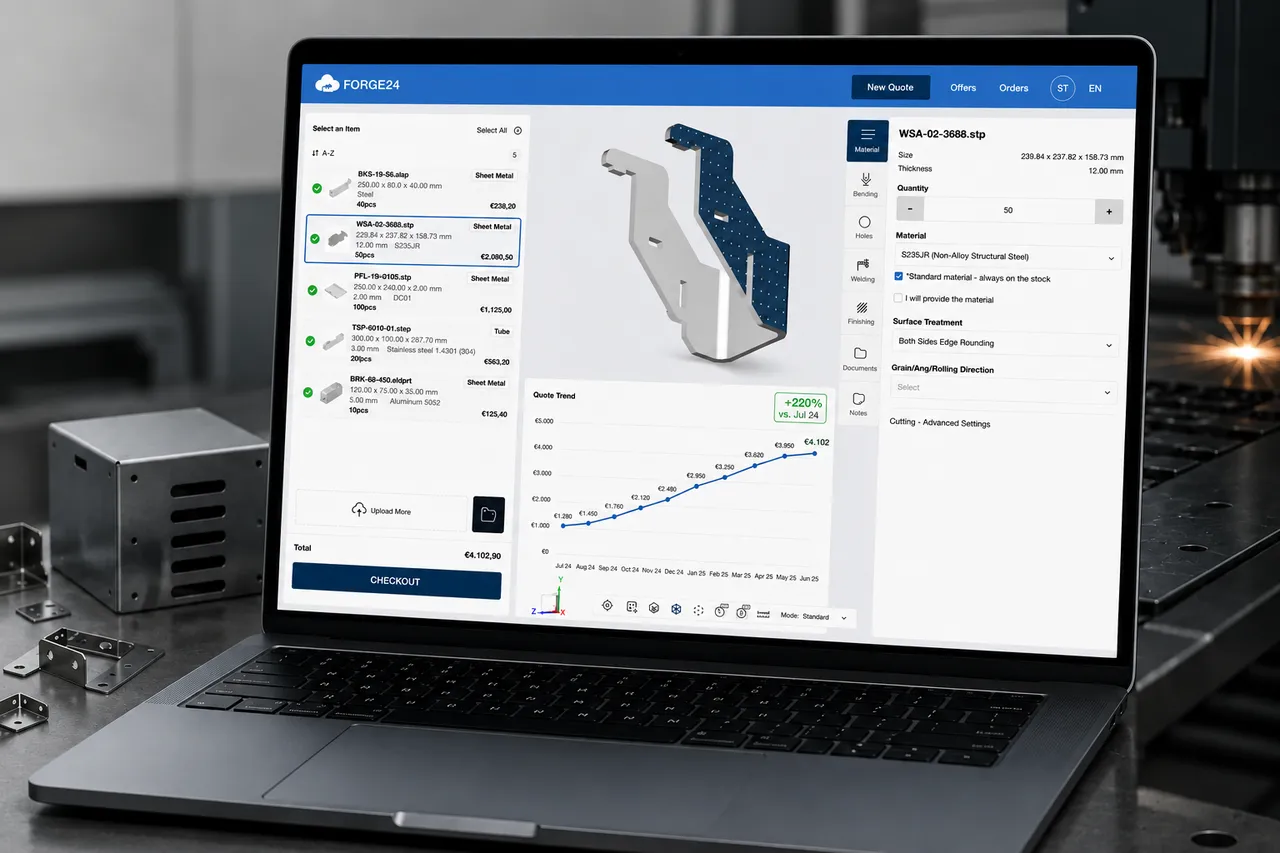
- A customer sends an email with a STEP file attached.
- An estimator downloads the file.
- The CAD model is reviewed manually.
- Material and production costs are calculated.
- A quotation is prepared.
- The customer receives a PDF.
- Several emails follow.
- Negotiations begin.
- Only then does production planning start.
In many companies, this process still consumes significantly more engineering time than it should. From my perspective, this is where the industry's next major productivity gains will come from.
The digitalization of manufacturing has only been half completed. We have automated production. Now we must automate commerce.
The Same Conversations Everywhere
One of the greatest privileges of building Oroox has been the opportunity to visit manufacturers and speak with management teams across many different countries.
Whether I am sitting in a meeting room in Germany, visiting a production facility in the Netherlands, discussing digital transformation with manufacturers in the United States, or presenting new technologies in Australia, I am often surprised by how similar the conversations become.
- Different languages.
- Different cultures.
- Different machinery.
Almost every managing director tells me some variation of the same story.
"We receive more quotation requests than ever before."
"Our engineers spend too much time preparing quotations."
"Finding experienced estimators has become extremely difficult."
"Customers expect answers much faster than we can provide them."
One topic appears in almost every discussion.
Manufacturers are increasingly losing RFQs - not because they cannot manufacture the parts, and not because their prices are too high - but because they simply cannot respond quickly enough.
Across many manufacturers I have spoken with, quotation turnaround times of one to two weeks are still surprisingly common for custom sheet metal parts.
For many companies, this has become normal.
For today's customers, it is increasingly unacceptable.
Procurement departments work under enormous time pressure.
If one supplier delivers a technically reliable quotation within seconds while another needs ten business days, the purchasing process often moves forward long before manufacturing quality or engineering expertise can even be evaluated.
In other words, manufacturers are increasingly losing business before they have had the opportunity to compete.
I believe quotation speed has quietly become one of the most important competitive advantages in our industry.
Being an excellent manufacturer is no longer enough.
Customers must also be able to access that excellence quickly.
What Our Research Revealed and what we expirience daily
At Oroox, we wanted to understand whether these conversations represented isolated experiences or reflected a broader change across the European manufacturing industry.
To answer that question, we conducted our own market research by interviewing sheet metal manufacturers across Europe about their views on online manufacturing and digital commerce.
The results confirmed many of my own observations.
Sixty-nine percent of the manufacturers we interviewed believe that online manufacturing will become an important part of their future business strategy.
Even more interesting, 43 percent have already made the strategic decision to invest in online manufacturing, while another 26 percent are actively evaluating the opportunity but have not yet reached a final decision.
That means nearly seven out of ten manufacturers already recognize that digital commerce will play an important role in their future.
But perhaps the most interesting finding was not whether companies wanted to move online.
It was why.
When asked about their primary motivation, the answers painted a clear picture of where the industry is heading.
- 51% want to expand their customer reach by making their manufacturing services accessible to new regional and international markets.
- 47% want to streamline quotation and order processing by reducing manual work and significantly accelerating response times.
- 29% want to increase operational efficiency through automation and standardized digital workflows.
What I find particularly interesting is that manufacturers are pursuing online manufacturing for two strategic reasons.
The first is growth. More than half of the companies we interviewed see online manufacturing as an opportunity to reach customers beyond their traditional geographic markets and make their services available 24 hours a day through digital sales channels.
The second is efficiency. Nearly half of the respondents are primarily focused on simplifying their internal quotation and order management processes. As RFQ volumes continue to rise while experienced estimators become harder to find, manufacturers increasingly recognize that automation is essential for scaling their business without proportionally increasing administrative headcount.
To me, these findings reinforce what I hear in conversations with manufacturers every week. Online manufacturing is no longer viewed simply as an e-commerce initiative. It is becoming a strategic business transformation that enables manufacturers to grow, improve operational performance, and deliver the digital purchasing experience that modern industrial buyers increasingly expect.
Source: Oroox Market Research 2026 – Interviews with sheet metal manufacturers across Europe.
Why This Transformation Reminds Me of the Printing Industry
Whenever I present online manufacturing to manufacturers, I often draw a comparison with another industry that experienced a remarkably similar transformation.
Commercial printing.
Twenty years ago, ordering printed products looked very much like ordering custom manufactured parts today.
Customers requested quotations by email or phone.
Artwork was exchanged several times.
Sales representatives manually prepared quotations.
Proofs had to be approved.
Production planning only started after numerous administrative steps.
The process worked.
But it was slow.
Then online printing platforms entered the market.
Customers suddenly gained the ability to upload their artwork, configure products, receive pricing instantly, place orders online and monitor production without speaking to a sales representative for standard jobs.
Many traditional printing companies initially believed this would never become mainstream.
They argued that every order was different.
That customers expected personal advice.
That printing was simply too complex for online ordering.
History proved otherwise.
Today, depending on the country and market segment, an estimated 30 to 40 percent of commercial printing business is generated through online ordering channels, with even higher shares for standardized products.
What changed was not the printing technology.
Printing presses still printed.
The production process remained largely the same.
The commercial process changed.
Standard orders moved online.
Routine administration became automated.
Sales teams shifted their focus toward complex, high-value projects where their expertise created the greatest value.
When I look at today's sheet metal processing industry, I cannot help seeing the same pattern emerging.
Manufacturing is certainly more complex than printing.
We analyse CAD models instead of artwork.
We validate manufacturability instead of printability.
We calculate production routes, bending sequences, material utilization, tooling, tolerances and logistics.
But complexity does not prevent digital transformation.
It simply requires more intelligent software.
In my opinion, we are now standing at the beginning of a similar journey.
Just as online printing became a standard way of purchasing printed products, I believe online manufacturing will become a standard way of purchasing manufactured components.
Not because it replaces people.
But because it allows people to focus on the work where they create the greatest value.
And I believe this transformation has only just begun.
Looking Ahead: My Perspective on the Future of Online Manufacturing
There is one question I am asked almost everywhere I go.
"Where do you think manufacturing will be in ten years?"
I always answer that question carefully because predicting the future is difficult. Technology rarely develops exactly as we expect. Unexpected innovations appear, markets change, and customer behavior evolves faster than anyone anticipates.
Nevertheless, after spending many years working with manufacturers around the world, there are several developments that I believe are becoming increasingly clear.
Manufacturing Will Become Increasingly Customer-Driven
For decades, manufacturing companies largely defined how customers had to buy.
Customers adapted to suppliers.
They accepted long quotation cycles.
They accepted manual communication.
They accepted limited transparency.
They accepted waiting.
I believe this relationship is changing fundamentally.
Future manufacturers will increasingly design their business around the customer's preferred buying experience.
- Customers will expect to upload CAD files whenever they want.
- They will expect immediate technical feedback.
- They will expect transparent pricing.
- They will expect to follow production progress in real time.
- They will expect digital communication as naturally as they expect online banking today.
This is not because customers are becoming impatient.
It is because every other industry has already changed.
Manufacturing is simply catching up.
The Website Will Become the Digital Front Door to Every Factory
Today, many manufacturing websites still function primarily as digital brochures.
- They describe the company.
- They present machines.
- They list certifications.
- They provide contact information.
In my opinion, this will change dramatically.
The manufacturing website will become the digital entrance to the factory itself.
Instead of simply reading about manufacturing capabilities, customers will interact directly with them.
- They will upload parts.
- Receive manufacturability feedback.
- Generate quotations.
- Place orders.
- Approve production.
- Track manufacturing progress.
- Manage invoices.
- Download certificates.
- Reorder existing components.
The website will no longer be a marketing tool.
It will become an integral part of the manufacturing operation.
Engineering Will Become More Valuable - Not Less
One concern I hear regularly is that increasing automation will reduce the importance of engineers.
Personally, I believe the opposite will happen.
Routine engineering work will become increasingly automated.
Complex engineering will become increasingly valuable.
The best engineers will spend less time preparing quotations and more time solving difficult manufacturing challenges.
Instead of manually calculating prices, they will improve manufacturing rules.
Instead of copying data into ERP systems, they will optimize production processes.
Instead of answering repetitive customer emails, they will work closely with customers on innovative products.
Technology has always changed how engineers work.
It has never reduced the importance of engineering expertise.
I see no reason why artificial intelligence will be different.
Data Will Become One of Manufacturing's Most Valuable Assets
For many years, manufacturers invested primarily in machines.
Tomorrow, I believe they will invest equally in data.
- Every quotation.
- Every production order.
- Every manufacturing decision.
- Every engineering correction.
- Every production deviation.
- Every customer interaction.
All of this information becomes valuable knowledge.
Manufacturers capable of learning from their own operational data will continuously improve pricing accuracy, production planning, lead time prediction and customer service.
Those who ignore this opportunity will increasingly compete against companies that become smarter with every quotation they process.
Manufacturing Commerce Will Become a Competitive Advantage
Today, manufacturers often compete using:
- Machine capacity.
- Production quality.
- Delivery performance.
- Technical expertise.
These will always remain important.
But I believe another competitive factor is emerging.
The ability to make buying remarkably easy.
- Customers remember experiences.
- They remember how quickly quotations arrived.
- How transparent communication was.
- How simple ordering became.
- How predictable delivery proved to be.
Manufacturers who remove friction from purchasing will increasingly differentiate themselves - not only through engineering excellence, but through customer experience.
My Advice to Manufacturers
If there is one lesson I have learned during my career, it is that digital transformation should never begin with technology.
It should begin with customers.
Instead of asking:
"Which software should we buy?"
I encourage manufacturers to ask different questions.
- How do our customers actually want to buy from us?
- Where do we lose time internally?
- Which manual activities create no additional value?
- How can our engineers spend more time engineering?
- How can we become easier to do business with?
Technology becomes much easier to select once those questions have been answered.
My Personal Prediction
People occasionally ask me what percentage of manufacturing business I believe will eventually move online.
The honest answer is that nobody knows.
But history offers useful clues.
Twenty years ago, very few people believed commercial printing would become a predominantly digital sales business.
Today, online ordering represents a significant share of that market.
- Travel changed.
- Banking changed.
- Retail changed.
- Insurance changed.
- Software changed.
Every industry digitalized the commercial experience once customers recognized its advantages.
I believe manufacturing will follow the same direction.
Not because factories will become less important.
Quite the opposite.
Factories will become even more important.
But the way customers discover, evaluate, purchase and collaborate with manufacturers will become fundamentally digital.
Whether that represents thirty percent, fifty percent or even more over the coming decade is impossible to predict.
What I feel confident predicting is this:
The manufacturers that begin building digital commercial capabilities today will almost certainly have a significant competitive advantage over those who wait until customer expectations have already changed.
Final Thoughts
When I founded Oroox, my vision was never simply to build quotation software.
My vision was to help manufacturers make it dramatically easier for customers to buy custom manufactured products.
Over the years, that vision has grown.
Today, I believe online manufacturing represents something much larger than software.
It represents the evolution of industrial commerce itself.
The manufacturing companies that succeed during the next decade will continue investing in outstanding production capabilities.
But they will invest equally in creating outstanding buying experiences.
Because at the end of the day, every manufactured part begins long before the laser starts cutting.
It begins with a customer deciding which manufacturer is the easiest, fastest and most trusted company to do business with.
In my opinion, that decision will increasingly be made online.
About the Author
Markus Hannes Winter is the Founder and CEO of Oroox AG, a software company specializing in online manufacturing, manufacturing commerce, and digital sales automation for the manufacturing industry. For more than 12 years, he has developed industrial software solutions and worked with manufacturers across Europe, North America, Australia, the Middle East, and Asia to help digitalize quotation, order management, engineering workflows, and customer collaboration.
The opinions expressed in this article are my own and are based on my professional experience working with manufacturers around the world.