The Shift to On-Demand Manufacturing: Why Product Companies Are Ordering Smaller Quantities More Frequently
Traditional bulk purchasing is giving way to a smarter, more flexible approach. Product companies are increasingly replacing large inventories with on-demand manufacturing, ordering only what they need, when they need it, while reducing costs, freeing up capital, and responding faster to market changes.
Over the past few years, I have observed a significant change in the purchasing behavior of product companies. More and more manufacturers of machines, equipment, electronics, furniture, and industrial products are moving away from buying large quantities of components and toward an on-demand purchasing model.
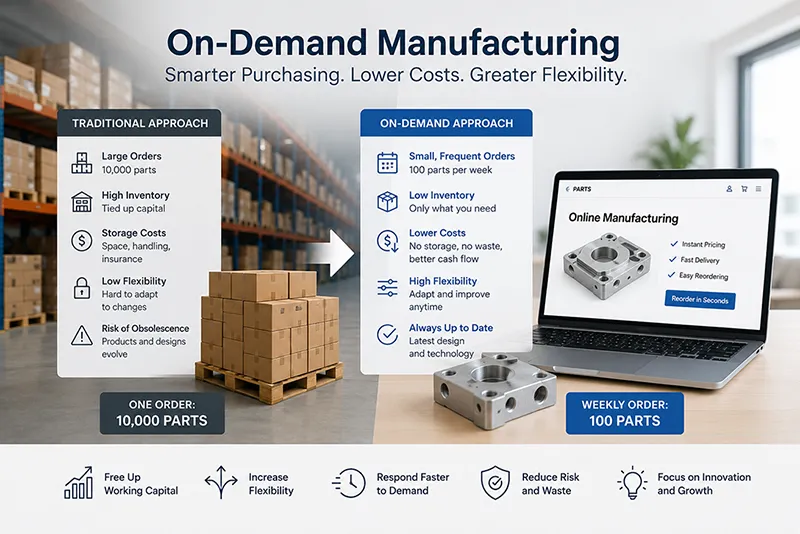
For decades, the goal was simple: negotiate the best unit price, order thousands of parts, and store them until they were needed. Today, that strategy is becoming increasingly difficult to justify.
Warehousing is expensive. Inventory ties up working capital. Products occupy valuable storage space, require handling, insurance, and administration, and can remain on the shelf for months before they are used.
Even more importantly, large inventories reduce flexibility.
Every product evolves. Engineers improve designs, customer requirements change, and new market opportunities emerge. When a company has thousands of components sitting in a warehouse, implementing even a small design improvement often means writing off perfectly usable inventory.
This is why I see more product companies changing their procurement strategy.
Instead of ordering 10,000 parts in a single purchase order, they may order just 100 parts every week. Components arrive exactly when they are needed for production, eliminating the need to finance months of inventory while maintaining the flexibility to adjust quantities or introduce engineering changes almost immediately.
Online Manufacturing Makes This Possible
This shift would not have been practical a few years ago.
Ordering small quantities repeatedly traditionally created a large administrative burden. Every order required new quotations, email exchanges, purchase orders, engineering reviews, and manual processing.
Online manufacturing has fundamentally changed this process.
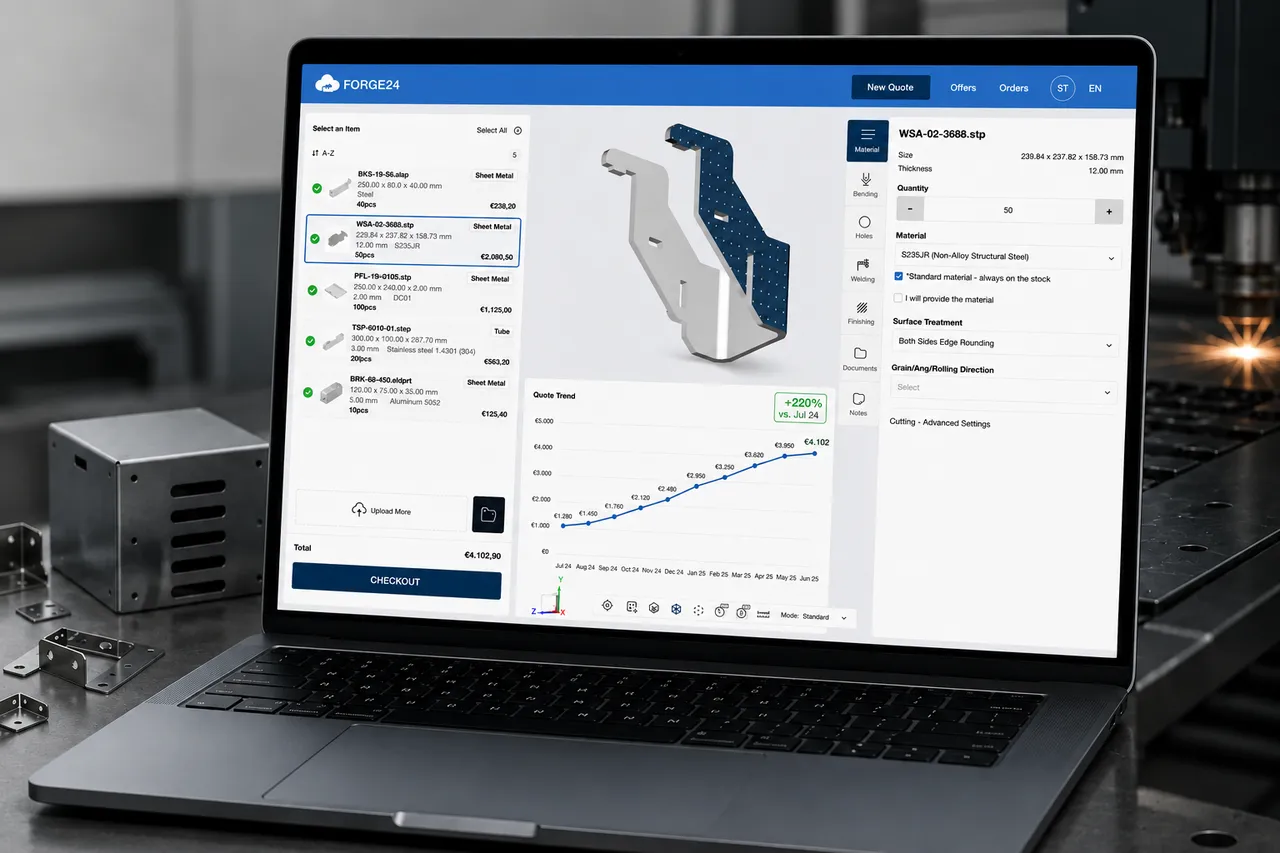
Today, product companies can upload CAD files once, receive instant pricing, save their configurations, and reorder identical parts with only a few clicks. Delivery schedules become predictable, production planning becomes easier, and purchasing teams spend far less time on administration.
Ordering 100 parts every week is no longer more complicated than placing one large annual order.
The Financial Benefits Go Beyond Lower Inventory
Many companies initially focus on reducing warehouse costs, but the financial impact is much broader.
By purchasing components only when they are needed, product companies can:
- Free up working capital instead of tying it up in inventory.
- Reduce warehouse space and storage costs.
- Minimize the risk of obsolete components after product changes.
- Improve cash flow and liquidity.
- Respond faster to fluctuations in customer demand.
- Introduce engineering improvements without waiting for existing stock to be consumed.
- Reduce waste caused by excess inventory.
The result is a more agile and financially efficient supply chain.
Flexibility Is Becoming More Valuable Than Bulk Discounts
Large orders have traditionally been justified by lower unit prices. While volume discounts will always exist, many companies now recognize that the hidden costs of inventory often outweigh the savings achieved through bulk purchasing.
Capital tied up in stock, warehouse operations, obsolete inventory, and reduced flexibility all contribute to the true cost of ownership.
In many cases, ordering exactly what is needed, when it is needed, delivers a stronger overall business case than purchasing large quantities at the lowest possible unit price.
What I See Across Our Global Manufacturing Network
One of the reasons I am convinced this trend will continue to accelerate is that I see it reflected in our data every week.
By analyzing the order volumes and purchasing patterns across our global network of manufacturing partners, especially in the United States, Europe, and Australia, I can clearly see that on-demand purchasing is becoming increasingly common among medium-sized and large product companies.
I see more businesses replacing occasional high-volume orders with smaller, recurring purchases that closely match their production schedules. Instead of filling warehouses with inventory, they are using online manufacturing platforms to reorder parts in just a few clicks whenever they are needed.
In my view, this is a clear sign that procurement priorities are changing. Product companies are placing greater value on flexibility, cash flow, and supply chain resilience than on simply achieving the lowest possible unit price through large-volume orders.
Based on what I observe every week, I believe on-demand manufacturing is no longer an emerging trend - it is becoming the new standard for industrial procurement.
A New Procurement Model
In my view, on-demand manufacturing represents one of the most important changes in industrial procurement.
Product companies are no longer optimizing solely for purchase price. They are optimizing for flexibility, cash flow, speed, and resilience.
Online manufacturing platforms enable this new way of working by connecting purchasing directly with production through digital processes, instant quoting, and fast reordering.
I believe this trend will continue to accelerate. As online manufacturing becomes more widespread, companies will increasingly replace warehouse-driven purchasing with demand-driven procurement.
The future is not about owning more inventory.
It is about having immediate access to manufacturing capacity whenever it is needed.
For product companies, that means lower costs, greater flexibility, faster innovation, and a supply chain that is better prepared for an increasingly dynamic market.