How to Choose the Best Sheet Metal Quoting Software: A Buyer's Guide
Find out how to choose sheet metal quoting software. Compare estimating accuracy, CAD automation, pricing features, integrations, and key selection criteria.
The right sheet metal quoting software is what distinguishes a truly competitive sheet metal fabricator with the quote speed and quality that meet customers' ever-tightening requirements.
Imagine a customer sending a request for quote at 5 pm on Friday. One sheet metal fabricating company will quote it only Monday afternoon. Another one will return a quote with the price and lead time included in ten minutes. This difference is drastic.
The best sheet metal estimating software reads your customers’ CAD files accurately, prices jobs using your real job shop costs, connects to your ERP and CRM, and automates routine quotes so your best people only touch the exceptions. It's not necessarily a product with the most features. But it should represent your particular manufacturing processes, reflect your pricing strategies, scale as you grown and fit your quoting workflows.
If you find the right solution, it can significantly improve how your sheet metal fabrication business estimates production costs, applies customer-specific pricing, and convert RFQs into manufacturing orders in a matter of a few minutes. Above all, this choice will be your essential step towards the digital manufacturing business model.
This guide for owners and senior leaders explains the key features of sheet metal fabrication estimating software, compares its different types, provides a practical framework for selecting the right solution as well as touches on the role of AI in the modern quoting software for sheet metal fabrication.
What Is Sheet Metal Quoting and Estimating Software?
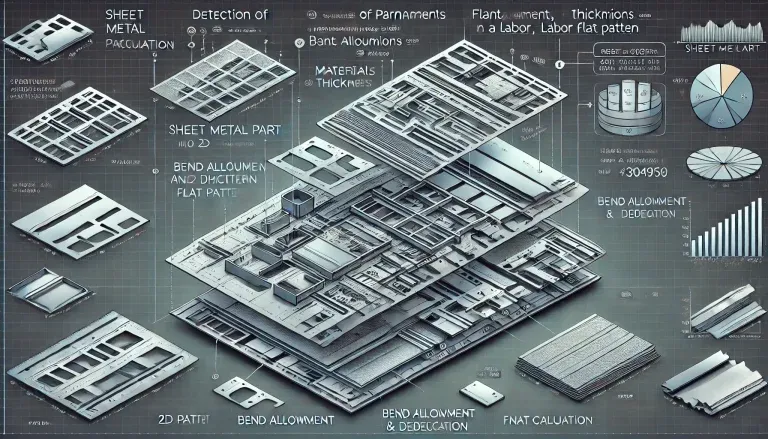
Sheet metal estimating software calculates how much it costs to fabricate a sheet metal part from its geometry, material, and the processes needed to make it. It typically reads a CAD file (DFX, DWG, or STEP), detects the features such as cuts, holes, and bends, and applies machine rates, material costs, and markups.
It's not quite the same as sheet metal quoting software, although the terms are often used interchangeably.
Below is a quick breakdown of key terms used in sheet metal quoting and estimating automation:
- Estimating software calculates the production costs which serve as the basis for calculating a customer-facing price at the next stage.
- Quoting software applies margins, customer-specific pricing, and other conditions to production costs to package them into a customer-facing quote.
- CPQ (configure, price, quote) is a product configurator from predefined options that applies manufacturing and commercial rules to the customer's product choice and shows them the respective price.
- Instant quoting often serves as the user interface for sheet metal quoting software and lets a customer calculate the price on their own from their uploaded CAD file.
Most modern platforms for digital manufacturers combine the first four and connect to the rest of the business systems.
Why Choosing the Right Sheet Metal Estimating Software Matters
For manufacturers planning to start or expand their digital sales, choosing the right quoting system is more than an operational software decision. It shows a manufacturer's digital maturity to the customer as it's their first interaction with the job shop, setting expectations for speed, accuracy and convenience of doing business.
For most manufacturers, though, estimation and quoting are scrupulously manual processes that sit in spreadsheets that only a few senior estimators can handle, while their tribal knowledge and judgement calls have never been documented.
Estimation and quoting automation addresses the problems of speed, consistency and dependency on key estimators while producing a clean cost and routing data for further digital order management. It also determines how efficiently a manufacturer's capabilities are offered to the market.
Some of the top-of-mind benefits brought by sheet metal fabrication quoting software are:
- Faster quote turnaround through geometry analysis and cost calculations. Estimators don't have to spend time interpreting drawings, measuring features and entering manufacturing parameters. As customers now expect a quote within hours rather than days, this is especially valuable for manufacturers who've previously lost orders to slow quoting.
- Higher estimating accuracy and consistency thanks to standardized calculation rules that reduce differences between individual estimators. Automated quoting produces accurate quotes that follow the same manufacturing assumptions. This can prevent margin erosion and overpricing on some jobs and increase order win rates.
- Better profitability control with detailed cost breakdowns and configurable pricing rules so manufacturers can identify cost drivers, protect margins and avoid underpricing for complex orders.
- Less dependency on pricing knowledge that only a few employees have and protecting that knowledge from these employees' retirement, turnover or illness that can disrupt business continuity.
- More quoting capacity to process higher volumes of RFQs without increasing estimating resources and staff. Thanks to that, manufacturers can also serve smaller orders and new customers who've been uneconomical to serve before.
- Better customer experience that contributes to competitiveness with instant quoting, transparent pricing and frictionless online ordering of custom sheet metal parts.
Signs Your Quoting Process Is Holding the Business Back
Manual quoting can cost you revenue. Check the following signs you could benefit from automating your estimating process and customer quoting:
- Customers wait for days to receive a quote, and you have a pending quote backlog.
- Your estimators spend most of their time on repeat or simple parts.
- Pricing varies depending on the estimator who builds the quote.
- You cannot easily explain why you won or lost a given job.
- Only one or two people truly understand how your pricing works.
- Growth would require hiring more estimators in proportion to volume.
- Your quotes live in spreadsheets, email, and a separate ERP, with re-keying between them.
See sheet metal quoting automation in action with Oroox
10 Key Features to Look for in Sheet Metal Quoting Software
The best sheet metal quoting software reflects how your sheet metal fabrication business actually operates. Look for the following capabilities during vendor evaluation.
1. CAD-Based Quoting and Automated Geometry Analysis
CAD-based quoting is changing sheet metal cost estimation as one of the most important capabilities for custom parts manufacturers.
CAD software can read files, analyze the geometry of CAD models, detect thickness, dimensions, holes, cutouts and bends. These identified features are then used for manufacturing cost calculation. CAD-integrated cost calculators can generate prices for parts based on their geometric parameters.
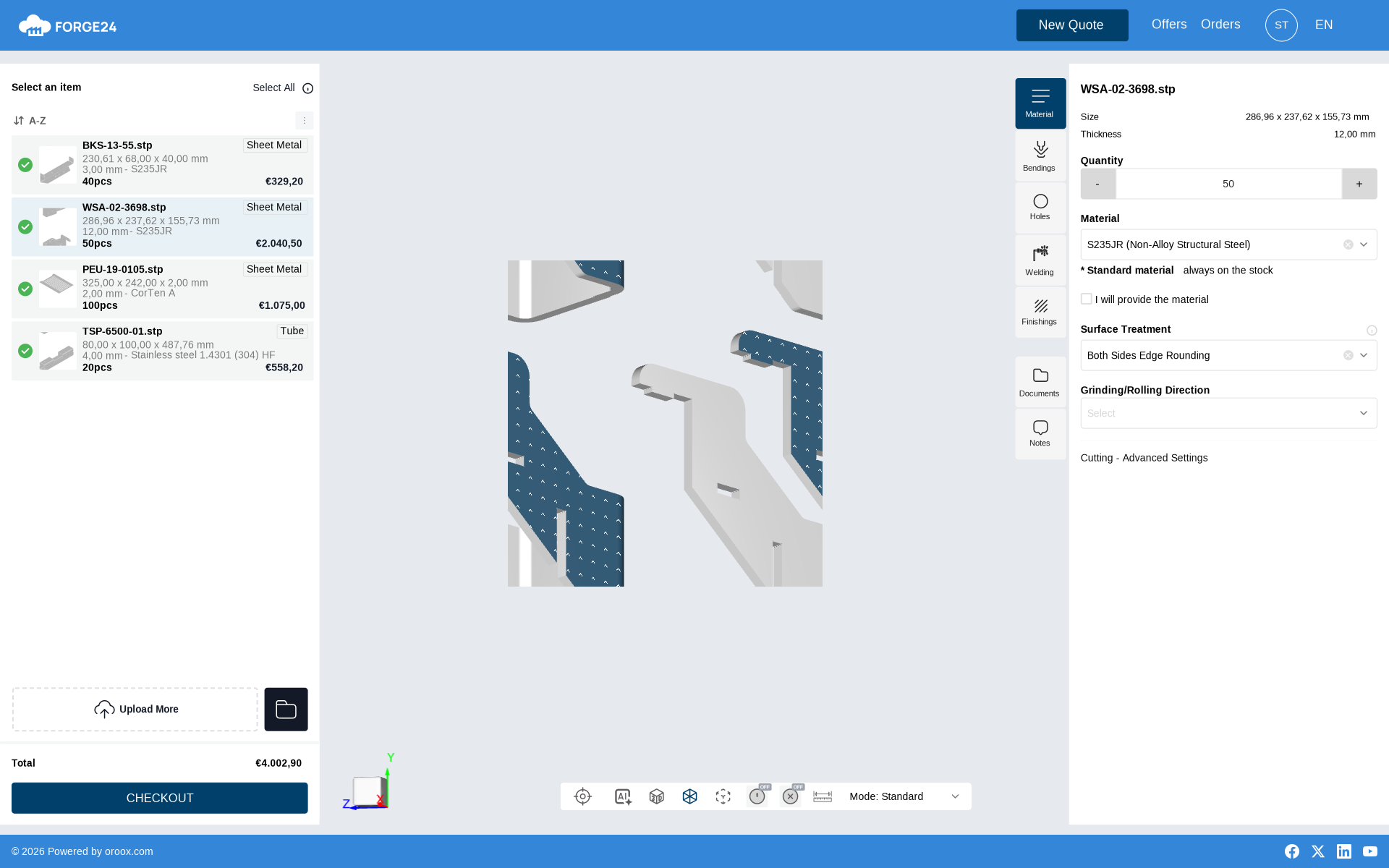
What to ask your vendor: Ask which CAD formats are supported (DXF, DWG, STEP, native CAD), whether the software can handle both 2D and 3D drawing formats, how it handles incomplete files, what happens when a feature is not recognized, and if the user can do any design updates while in the system.
2. Accurate Material Cost Estimation and Nesting
Sheet metal fabrication estimating software should account for your job shop operational specifics, not the industry average. It should be able to handle your machine rates, material types, cut and bend times, thickness, sheet dimensions, purchasing prices, and expected material utilization. Material costs in particular are important for accurately pricing of a sheet metal part.
2D nesting capabilities help further improve estimation by showing how efficiently parts can be arranged on a single sheet for better material utilization. Using nesting, you can also manage scrap, cutting allowances, and material consumption. Not every sheet metal estimating software comes with the production-grade nesting option. Some use simplified utilization factors or approximate nesting calculations.
What to ask your vendor: Ask how the software is calibrated for accuracy; how you can compare its estimates against actual job costs over time; whether the software uses actual nesting calculations, estimated utilization factors, or fixed material allowances, and how closely these reflect production results.
3. Support for Your Manufacturing Processes
Estimating software for sheet metal fabricators is only as good as the manufacturing processes it supports.
For example, if laser cutting and bending are your key sheet metal manufacturing operations, the cost calculation solution should account for material type, thickness, gauge, cutting length, piercing operations, bend count, tooling, machine setup, part complexity and many other specific parameters. Advanced sheet metal estimation software can combine geometric information with other machine and process parameters.
For some processes, additional customer specifications or estimator input may be required, especially if CAD geometry is lacking details.
What to ask your vendor: Can the software represent your machines, production rates, setup assumptions, and bending requirements? Can the system estimate multiple components, recognize required operations, and combine costs into a consolidated quotation for complex multi-process manufacturing?
4. Customizable Pricing Rules and Margin Control
Quoting systems are not "set and forget". As your data changes, your team should be able to update pricing rules, machines, materials and customer data without asking the vendor to do it.
Configurable pricing rules should include material and machine-rate markups, customer-specific prices and discounts, margins, surcharges, quantity-based pricing and more.
What to ask your vendor: Check if your commercial team will be able to update pricing parameters independently as well as maintain appropriate approval controls.
5. Instant Quoting and RFQ Automation
There is a range of tools to fully automate instant quoting, especially for those manufacturers who deal with high-volume quoting workflows. Instant quoting software can connect CAD analysis, manufacturing cost estimation, pricing, and quote generation into one continuous workflow. This reduces manual effort required between receiving an RFQ and delivering an offer, while automated quoting generates quotes in minutes instead of hours.
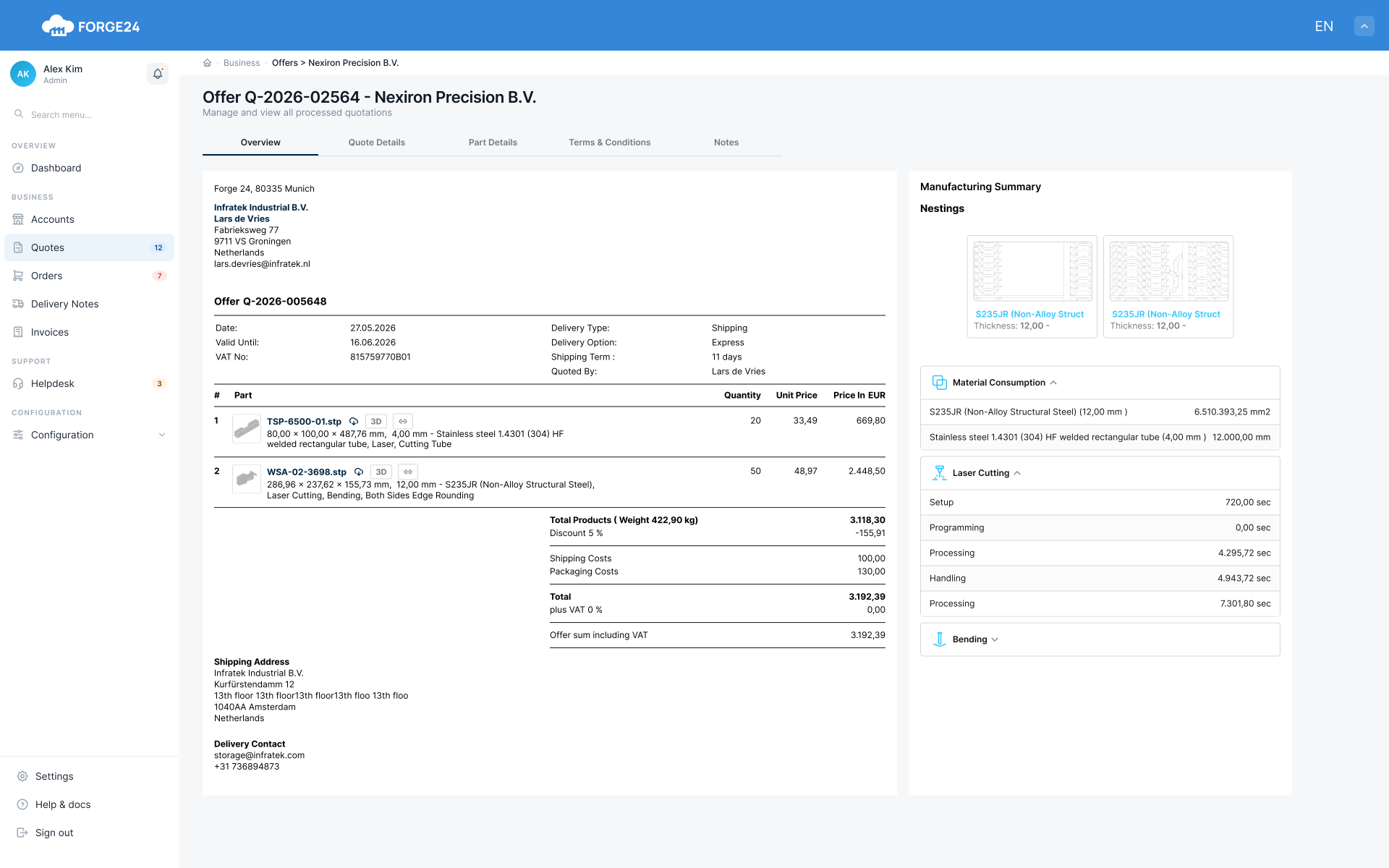
There are also hybrid systems where automation for repeated quotes sits next to manual review and approval workflows for special jobs.
What to ask your vendor: What percent of your typical RFQs can the software automate without requiring any intervention? How does it handle exceptions? Can it process multiple parts, manage different quantities, and generate consistent quotations?
6. ERP, CRM and CAD Integrations
Quoting software should connect with the systems that support your manufacturing and commercial operations in order to reduce manual data re-entry and keep information moving in a reliable flow.
Integration with ERP systems allows for synchronizing material prices, customer data and order information, while connecting your CRM to quoting software would reduce the need to manually transfer customer account data and support sales workflows. CAD integration may simplify management of design files and technical data.
What to ask your vendor: Which integrations are native, which require custom development, and how are data ownership and synchronization handled? What data flows in which direction?
7. Customer Self-Service and Online Quoting
A customer self-service portal turns quoting from an internal task into a sales channel. This capability is particularly valuable for repeatable custom parts, small-batch production, and customers who are used to a digital buying experience.
Online sheet metal quoting allows customers to upload CAD files and specify all the manufacturing parameters to see the final price calculated automatically, without waiting for a salesperson, at any time of day. Some tools only provide basic online quote request forms, others offer full-scale digital manufacturing commerce automation with checkout, payments, order management and BOM transfer to downstream systems.
What to ask your vendor: Can customers place their orders online or does the system only support quote generation and stop there?
8. Quoting Analytics and Reporting
Quoting and estimating software for sheet metal fabrication should have quoting analytics built in, so you can see which quotes are won, lost or blocked. This way you can track the success rate of your quotes and have real-time visibility into sales performance and customer demand.
More advanced analysis can compare estimated and actual production costs to identify pricing errors and improve estimating models.
What to ask your vendor: Which metrics are available by default and which require integration with other systems? Can it compare estimated cost with actual job cost, as well as show profitability by quote and export data to BI tools?
9. Scalability
Your manufacturing capacity may grow in volume, machines, locations, and complexity. Your automated quoting system should accommodate these changes without proportional effort increase. If configuring manufacturing rules will require custom development or vendor assistance, it may prove inefficient down the line.
What to ask your vendor: How much effort will it be required to expand the solution over the next several years? How does the system perform with large assemblies and multiple sites? How easy is it to add machines, materials, users, locations and pricing models? How are new processes (laser, punch, welding, etc.) added?
10. Support and Implementation
Consider availability of onboarding, technical support, training, documentation and maintenance assistance from the vendor. Implementation timeline also matters, as well as how much your internal team's effort will be required. At the end, onboarding quality will contribute to time to value as much as the features.
What to ask your vendor: What's the realistic go-live timeline and what will be required from your team? What's included in post-implementation support and knowledge resources?
Types of Sheet Metal Estimating Software: Which Is Right for You?
Choosing the right sheet metal estimating software is a matter of matching your production and commercial specifics to what the system can reasonably automate. It also depends on your quote volume, parts complexity, and whether you want customers to generate quotes and place orders independently.
Some job shops will find that Excel spreadsheets and manual RFQ intake is more than enough. For others, CAD-driven RFQ processing and customer portals will be essential. Traditional estimating and quoting tools calculate costs and generate offers, but no more than this. A manufacturing e-commerce platform will make your capabilities fully available for online ordering through customer-facing quoting automation and checkout.
Understanding the main software categories listed in the table below will help you narrow down your choice.
| Software category | Main capabilities | Best suited for |
| Spreadsheet-based estimating tools | Manual formulas, material calculations, labor and machine-rate estimates | Small shops with limited RFQ volumes and relatively simple operations |
| Traditional fabrication estimating software | Structured cost calculations, process libraries, labor rates, quote documentation | Fabricators looking to standardize internal estimating |
| CAD-based manufacturing quoting software | Geometry recognition, automated process cost estimation, quotation generation | Custom manufacturers receiving CAD-driven RFQs |
| Manufacturing quoting and order management software | Quoting, job administration, order conversion, workflow management | Fabricators seeking closer integration between sales and production |
| Manufacturing digital commerce platforms | CAD-based quoting, customer self-service, digital ordering, commercial workflows | Manufacturers seeking to sell custom manufacturing capabilities online |
| HVAC sheet metal estimating software | Ductwork takeoffs, fittings, labor units, project and installation estimates | HVAC contractors and mechanical construction businesses |
A Few Words About AI-Based Sheet Metal Quoting Software
AI-based methods may be useful for analyzing unstructured RFQs, understanding drawings, or finding patterns in your historical production data, but their reliability depends on the quality and relevance of data fed into it. At the same time, rule-based calculation solutions are more transparent in terms of how costs are calculated, and this can always be traced to specific materials, operations, and parameters.
Most of the time, quoting and estimating platforms follow hybrid approaches, combining information extraction with structured rule-based manufacturing calculations.
For manufacturing cost estimation, however, it's more important for the calculation to be accurate rather than AI-powered. If you can find a proven AI-based cost calculation solution, treat it as a fast-track to your quoting automation but ask the vendor for accuracy evidence on parts like yours.
Here's a quick comparison on quoting technologies with their capabilities, advantages and considerations to have in mind:
| Technology approach | Typical capabilities | Main advantages | Considerations |
| Manual and rules-based estimating | Predefined formulas, machine rates, material costs, labor calculations | Transparent calculations and direct control over cost assumptions | Often requires manual data entry |
| CAD-based automated estimating | Geometry analysis, feature recognition, process-based cost calculations | Faster quoting, reduced manual measurement, consistent calculation logic | Accuracy depends on CAD compatibility and manufacturing rules |
| AI-assisted estimating | Drawing interpretation, information extraction, predictive cost models | Can reduce manual interpretation and support complex data processing | Requires validation, representative data, and explainable results |
| Hybrid AI and rules-based systems | AI-assisted data extraction combined with structured cost calculations | Potential balance between flexibility and calculation transparency | Implementation complexity and AI capabilities vary by vendor |
How to Compare the Best Sheet Metal Quoting Software
No single estimating and quoting automation platform fits every shop. Use the recommendations below for a structural approach to product selection. This short comparison checklist will help you ensure vendors are assessed on the same basis.
Define Your Manufacturing and Quoting Requirements
Your job shop's requirements should be the starting point, not the vendor's feature list. Document your most common RFQ scenarios, parts to be quoted, manufacturing processes, materials, and typical customer workflows that should be either fully automated or augmented with automation. It also helps to separate must-have features from nice-to-have ones.
Compare Features, Pricing and Total Cost of Ownership
The price of estimating software depends on the deployment model, quoting volumes, automation features included, and implementation effort. Some vendors charge per quote plus subscription packages.
Compare the total cost of ownership as it can be rather different from licensing fees only. Add onboarding, configuration, integrations, data preparation, training and maintenance costs.
You can review Oroox's pricing plans to understand available commercial options.
Test the Software with Real CAD Files and RFQs
Don't rely on vendor demos alone when selecting sheet metal quoting software. Prepare a representative set of your own RFQs and actual customer parts and compare the software results with your historical quotations and actual production costs.
Evaluate ROI and Implementation Requirements
The return on investment from sheet metal fabrication estimating software is more than just time saved on quote processing.
Other payoffs can include reduced estimating effort, higher RFQ throughput, more consistent pricing, improved conversion rates, and increased revenue from orders that were previously too expensive to process manually. For example, automated quoting can reduce take-off time by up to 90% for routine RFQs.
Your business case will be stronger if it combines operational efficiency with a plan for using the capacity released by automation.
Conclusion: Choosing the Right Sheet Metal Quoting Software
Choosing the right sheet metal quoting software should factor in your own manufacturing requirements. The best sheet metal quoting software should accurately calculate the costs, reflect your production processes, and integrate with your business systems well.
In summary:
- When selecting vendors, evaluate accuracy, automation scope, available integrations, and customer self-service experience.
- Test the product with your own CAD parts information to compare against your actual quotes.
- Treat the adoption of sheet metal quoting and estimating software as part of your digital transformation, not one disconnected action.
If you're looking to expand your digital sales, consider the next step: connect your automated quoting with a digital storefront and customer self-service. This way, manufacturing quoting will become part of your broader commercial strategy.
Oroox Manufacturing Commerce supports this transition by combining automated CAD-based manufacturing quoting with digital commerce capabilities for custom manufacturing.
Explore Oroox's sheet metal quoting software and CNC machining quoting software to see how automated cost estimation and online ordering can work together.
FAQ:
What is the best sheet metal estimating software for a small or mid-sized shop?
The best sheet metal estimating software is the one that fits your business most. This includes accurate quoting based on your manufacturing processes as well as the pricing that works for you. Most products for small to mid-sized manufacturers are priced based on quote volume plus automation features on subscription.
Where can I find sheet metal estimating software?
You can find sheet metal estimating software through specialized manufacturing software vendors, business directories or product ranking websites. There's no single place to find all available products as they range from CAD-based automated quoting to complete manufacturing ecommerce platforms. Start with your requirements and request a demo to evaluate vendors.
What is the difference between sheet metal estimating software and quoting software?
Sheet metal estimating software calculates the production costs, including material costs, machine rates, labor, and other. Quoting software takes this number and adds pricing rules on top, such as discounts, margins, delivery conditions, etc. to produce a customer-facing price. Many platforms on the market combine both types of capabilities.
Can sheet metal quoting software calculate prices directly from CAD files?
Yes, CAD-based geometry recognition and analysis is one of the key features of many sheet metal quoting solutions. Such systems extract geometric characteristics, such as cutting contours, holes, bends, and other features to use in cost calculation.
How accurate is automated sheet metal cost estimation?
Accuracy depends on the type of automation (AI or rule-based) and the quality of manufacturing data. To produce consistent estimates, use realistic prices, machine rates, process times and setup costs and test accuracy against your actual production costs. Complex assemblies or unusual parts may still require manual review and validation.
Can quoting software handle sheet metal assemblies and secondary operations?
Confirm with your vendor whether their quoting software supports assemblies and additional processes, such as welding, finishing and coating as not every operation can be pulled automatically from CAD.
Is AI necessary for accurate sheet metal estimating?
No, many sheet metal quoting and work order software products rely on deterministic rules and CAD-based geometry analysis to accurately calculate a price. AI can add value by interpreting drawings, extracting information and giving manufacturability recommendations.
Can customers get instant sheet metal quotes online?
Yes, contemporary sheet metal quoting automation solutions include customer self-service portals and sort of storefronts where customers can generate instant quotes independently from the manufacturer's sales team. This is still rare, but digital manufacturing is increasingly becoming a strong competitive differentiator.
How much does sheet metal estimating software cost?
Pricing varies depending on the number of users, automation features included, integrations, support of multiple production sites, and quote volumes, among other parameters. There are also additional implementation and customization costs to consider, especially for advanced CAD-based quoting systems and manufacturing commerce platforms.